
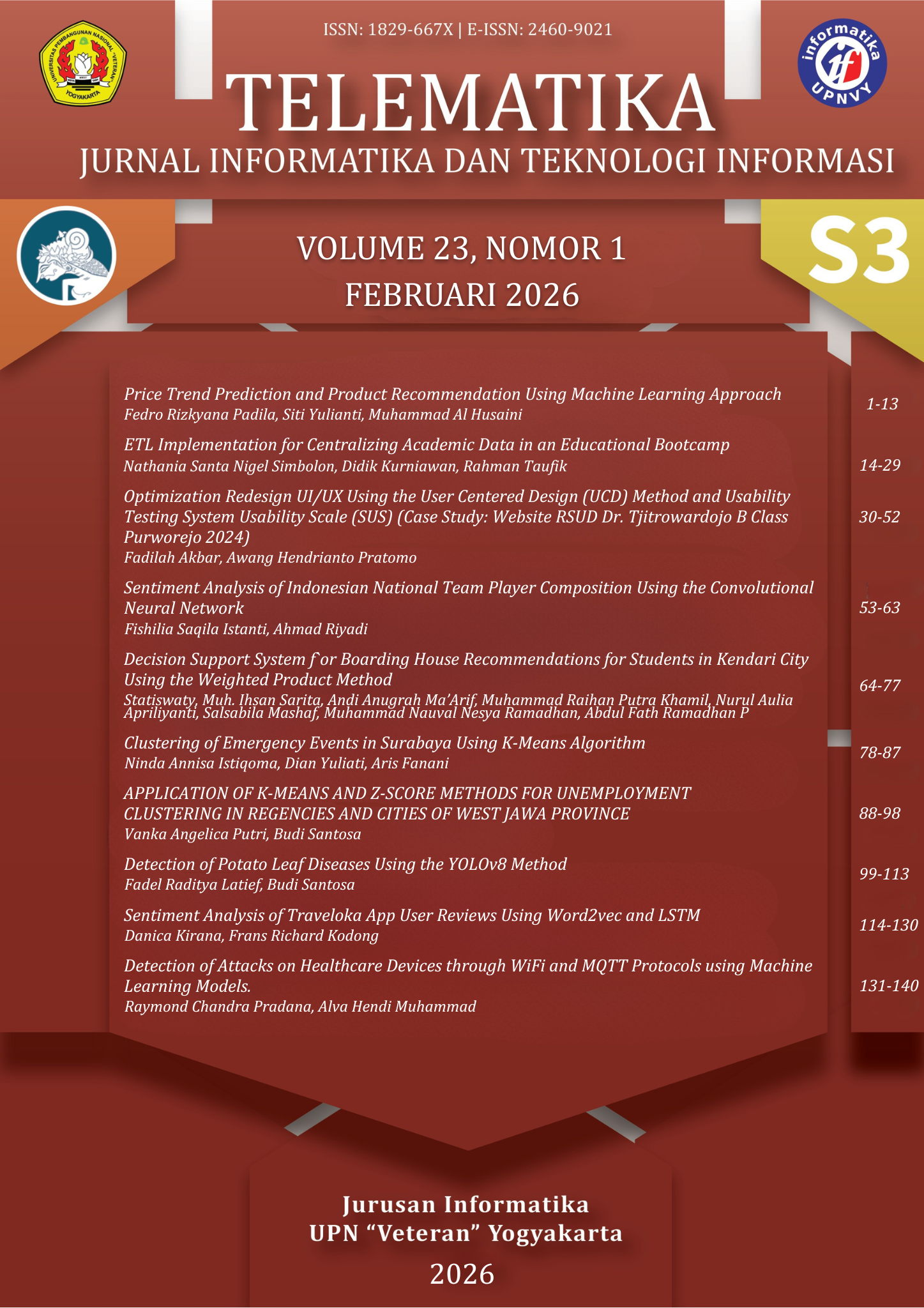
Sentiment Analysis of Indonesian National Team Player Composition Using the Convolutional Neural Network
Published 2026-08-12
Keywords
- Kata kunci,
- Analisis sentimen,
- komposisi pemain,
- Tim nasional indonesia,
- Convolutional Neural Network.
How to Cite
Copyright (c) 2026 Telematika : Jurnal Informatika dan Teknologi Informasi

This work is licensed under a Creative Commons Attribution-NonCommercial-ShareAlike 4.0 International License.
Abstract
Football is one of the most popular sports in Indonesia, especially when it comes to supporting the Indonesian National Team. The composition of the national team players is a frequently discussed topic among the public, particularly on social media platforms like YouTube. YouTube is one of the most popular social media platforms for expressing public opinions. Sentiment analysis can help identify and address issues based on public opinions shared on social media platforms such as YouTube.The classification method used in this study is Convolutional Neural Network. The dataset was obtained through data scraping, resulting in 3,200 data points. The labeling process was conducted manually by involving three annotators. The labeling results indicate 1,036 instances of "proportional," 1,416 of "not proportional," and 747 of "doubtful."Next, preprocessing was performed on the labeled data, followed by word weighting using TF-IDF. After that, modeling was conducted using Convolutional Neural Network, and the final step involved developing an interactive web application using Streamlit to analyze text sentiment based on the trained model. The accuracy result, comparing 80% training data and 20% testing data, achieved an accuracy of 89%. Meanwhile, the sentiment analysis results show that the "not proportional" sentiment appeared more frequently than the "proportional" and "doubtful" sentiments.
References
- E. C. Tyas Gusti, Eti Setiawati, and W. Warsiman, “Strategi Media Daring Kompas.com dalam Membentuk Identitas Sepak Bola Nasional: Analisis Wacana Model Theo van Leeuwen,” J. Onoma Pendidikan, Bahasa, dan Sastra, vol. 10, no. 3, pp. 3099–3118, Jul. 2024, doi: 10.30605/onoma.v10i3.3919.
- M. A. Java, Mohammad Syafrullah, W. Windarto, and P. Painem, “Analisis Sentimen Ulasan Pengguna Aplikasi Threads pada Google Play Store Menggunakan Multinomial Naive Bayes dan Support Vector Machine,” J. Ticom Technol. Inf. Commun., vol. 12, no. 2, pp. 75–80, Jan. 2024, doi: 10.70309/ticom.v12i2.112.
- F. D. Ananda and Y. Pristyanto, “Analisis Sentimen Pengguna Twitter Terhadap Layanan Internet Provider Menggunakan Algoritma Support Vector Machine,” MATRIK J. Manajemen, Tek. Inform. dan Rekayasa Komput., vol. 20, no. 2, pp. 407–416, 2021, doi: 10.30812/matrik.v20i2.1130.
- M. F. Rizki, K. Auliasari, and R. Primaswara Prasetya, “Analisis Sentiment Cyberbullying Pada Sosial Media Twitter Menggunakan Metode Support Vector Machine,” JATI (Jurnal Mhs. Tek. Inform., vol. 5, no. 2, pp. 548–556, 2021, doi: 10.36040/jati.v5i2.3808.
- A. L. Fairuz, R. D. Ramadhani, and N. A. F. Tanjung, “Analisis Sentimen Masyarakat Terhadap COVID-19 Pada Media Sosial Twitter,” J. Dinda Data Sci. Inf. Technol. Data Anal., vol. 1, no. 1, pp. 42–51, Feb. 2021, doi: 10.20895/DINDA.V1I1.180.
- R. Vindua and A. U. Zailani, “Analisis Sentimen Pemilu Indonesia Tahun 2024 Dari Media Sosial Twitter Menggunakan Python,” JURIKOM (Jurnal Ris. Komputer), vol. 10, no. 2, p. 479, 2023, doi: 10.30865/jurikom.v10i2.5945.
- A. A. Permana, M. F. Fahrezi, D. A. Kristiyanti, and M. Sihotang, “Sentimen Analisis Opini Masyarakat Pada Media Sosial Twitter Terhadap Vaksin Berbayar Menggunakan Metode Naïve Bayes Classifier (Nbc),” J. Tek., vol. 10, no. 2, pp. 84–92, 2021, doi: 10.31000/jt.v10i2.5471.
- R. Naquitasia, D. H. Fudholi, and L. Iswari, “Analisis Sentimen Berbasis Aspek pada Wisata Halal dengan Metode Deep Learning,” J. Teknoinfo, vol. 16, no. 2, p. 156, 2022, doi: 10.33365/jti.v16i2.1516.