
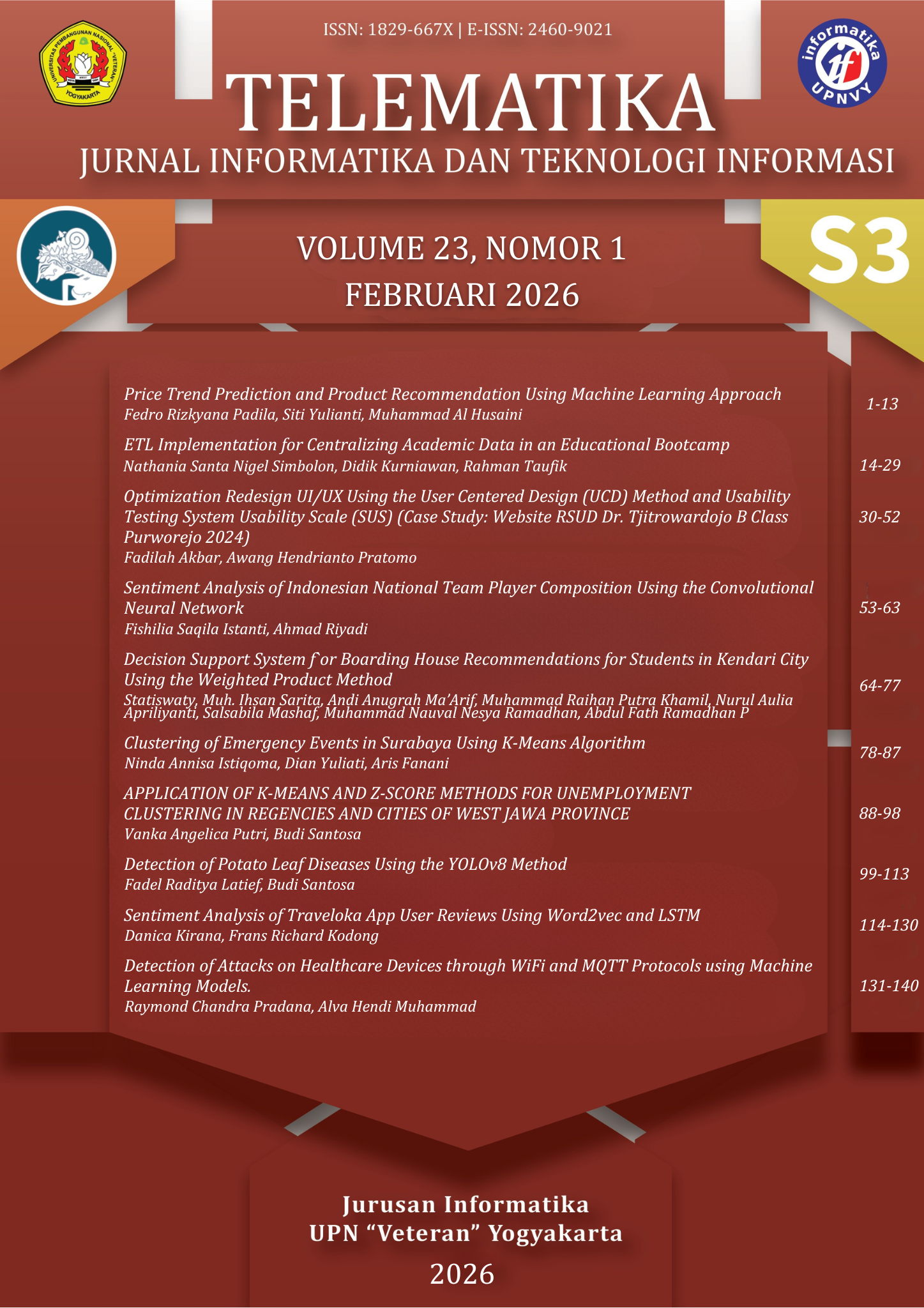
Decision Support System f`or Boarding House Recommendations for Students in Kendari City Using the Weighted Product Method
Diterbitkan 2026-08-12
Kata Kunci
- Mahasiswa,
- Sistem Penunjang Keputusan,
- Weighted Product
Cara Mengutip
Hak Cipta (c) 2026 Telematika

Artikel ini berlisensiCreative Commons Attribution-NonCommercial-ShareAlike 4.0 International License.
Abstrak
Purpose: This research aims to develop a Decision Support System that is able to provide boarding house recommendations for students in Kendari City. This system is designed to make it easier for students to choose a boarding house that suits their criteria and preferences.
Design/methodology/approach: This study uses the Weighted Product (WP) method. Boarding house data was obtained through field surveys and information collection from boarding house providers in Kendari City. The criteria considered include the type of boarding house, monthly rental price, distance to campus, facilities, availability of toilets, availability of kitchens, and security. Each criterion is weighted according to its level of importance.
Findings/result: The research results show that the DSS developed is able to provide boarding recommendations that suit student preferences. This system makes it easier for students to find boarding houses that best suit their needs.
Originality/value/state of the art: Previously, boarding house recommendation systems were rarely implemented with a WP-based approach that considered various criteria simultaneously. This research is expected to contribute to the development of a recommendation system that can be implemented in various other cities by adjusting relevant variables and criteria weights.
Referensi
- S. Steven and K. Christianto, “Aplikasi AturKost Berbasis Web Untuk Pengelola dan Penghuni Kost (Studi Kasus: Kost Jura),” JBASE - Journal of Business and Audit Information Systems, vol. 4, no. 2, pp. 41–54, Oct. 2021, doi: 10.30813/jbase.v4i2.3003.
- Rizky Jelang Ramadhani, Ivan Althirafi R., Rifardhi Reza S., Astian Afif A., and Retno Aulia Vinarti, “Sistem Pendukung Keputusan Pemilihan Kost Murah di Surabaya untuk Mahasiswa ITS dengan Metode Simple Additive Weighting (SAW),” Journal of Advances in Information and Industrial Technology, vol. 3, no. 2, pp. 1–10, Nov. 2021, doi: 10.52435/jaiit.v3i2.108.
- F. Angela Renya Seran, Y. P. Kelen, and D. Nababan, “Sistem Pendukung Keputusan Penentuan Jurusan Menggunakan Metode Weighted Product,” TEKNO KOMPAK, vol. 17, no. 1, pp. 147–159, 2023.
- S. Manurung, “Sistem Pendukung Keputusan Pemilihan Guru dan Pegawai Terbaik Menggunakan Metode Moora,” Jurnal SIMETRIS, vol. 9, no. 1, Apr. 2018.
- T. Adriantama and Y. Brianorman, “Sistem Pendukung Keputusan Dalam Seleksi Tempat Tinggal (Kost) Mahasiswa Dengan Metode Simple Additive Weighting (SAW) Decision Support System In Selection Of Student Stays (Kost) With Simple Additive Weighting (SAW) Method,” Jurnal Digital Teknologi Informasi, vol. 4, no. 1, pp. 1–7, 2021.
- A. Sudiarjo and M. Hikmatyar, “Kombinasi Metode Analytic Hierarchy Process Dan Weighted Product Pada Rekomendasi Pemilihan Tempat Kost,” Jurnal Teknik Informatika dan Sistem Informasi, vol. 9, no. 1, pp. 2407–4322, 2022, [Online]. Available: http://jurnal.mdp.ac.id
- S. Nurhidayat, A. Maulana, W. Gama Kusuma, and P. Rosyani, “Perbandingan Metode SAW, WP, Dan TOPSIS Dalam Pemilihan Rumah Kost Mahasiswa Di Pontianak,” OKTAL : Jurnal Ilmu Komputer dan Science, vol. 2, no. 8, pp. 2176–2186, Aug. 2023, [Online]. Available: https://journal.mediapublikasi.id/index.php/oktal
- F. Nidaul Khasanah et al., “Rekomendasi Hasil Metode Weighted Product terhadap Pemilihan Tempat Kuliner di Sekitar Universitas Bhayangkara Bekasi Recommendation Results of Weighted Product Method Towards the Selection of Culinary Place Around Universitas Bhayangkara in Bekasi,” Techno.COM, vol. 20, no. 3, pp. 382–391, 2021, [Online]. Available: https://trends.google.com
- R. Kumar, A. Bhattacherjee, A. D. Singh, S. Singh, and C. I. Pruncu, “Selection of portable hard disk drive based upon weighted aggregated sum product assessment method: A case of Indian market,” Measurement and Control (United Kingdom), vol. 53, no. 7–8, pp. 1218–1230, Aug. 2020, doi: 10.1177/0020294020925841.
- P. Rani and A. R. Mishra, “Multi-criteria weighted aggregated sum product assessment framework for fuel technology selection using q-rung orthopair fuzzy sets,” Sustain Prod Consum, vol. 24, pp. 90–104, Oct. 2020, doi: 10.1016/j.spc.2020.06.015.
- V. M. M. Siregar, S. Sonang, and E. Damanik, “Sistem Pendukung Keputusan Penentuan Pelanggan Terbaik Menggunakan Metode Weighted Product,” Jurnal Teknik Informasi dan Komputer (Tekinkom), vol. 4, no. 2, p. 239, Dec. 2021, doi: 10.37600/tekinkom.v4i2.392.
- H. Apriadi, F. Amalia, and B. Priyambadha, “Pengembangan Aplikasi Kakas Bantu Untuk Menghitung Estimasi Nilai Modifiability Dari Class Diagram,” Jurnal Pengembangan Teknologi Informasi dan Ilmu Komputer, vol. 3, no. 11, pp. 10605–10613, Nov. 2019, [Online]. Available: http://j-ptiik.ub.ac.id
- C. Nurqueen Paradis, M. Robert Yusuf, M. Farhanudin, and M. Ainul Yaqin, “Analisis dan Perancangan Software Pengukuran Metrik Skala dan Kompleksitas Diagram Class,” JACIS : Journal Automation Computer Information System, vol. 2, no. 1, pp. 58–65, May 2022.
- V. Ayu, “Pemodelan Proses Pemilihan Rute pada Protokol Babel dengan Activity Diagram dan Transition System,” Media Teknika Jurnal Teknologi, vol. 12, no. 1, pp. 58–66, Jun. 2017.
- A. Gutama, A. Arwan, and L. Fanani, “Pengembangan Kakas Bantu Pembangkitan Kasus Uji pada Model-Based Testing Berdasarkan Activity Diagram,” Jurnal Pengembangan Teknologi Informasi dan Ilmu Komputer, vol. 3, no. 9, pp. 8325–8334, Sep. 2019, [Online]. Available: http://j-ptiik.ub.ac.id